


Free Shipping
on orders over $500

Lifetime Support
from the experts

Money Back Guarantee
Not happy? Send it back!

Two temperature sensors side by side

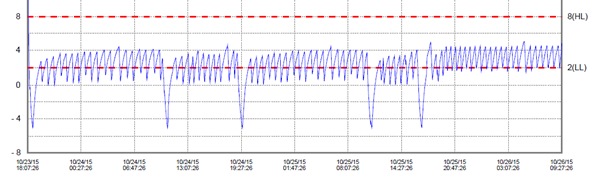
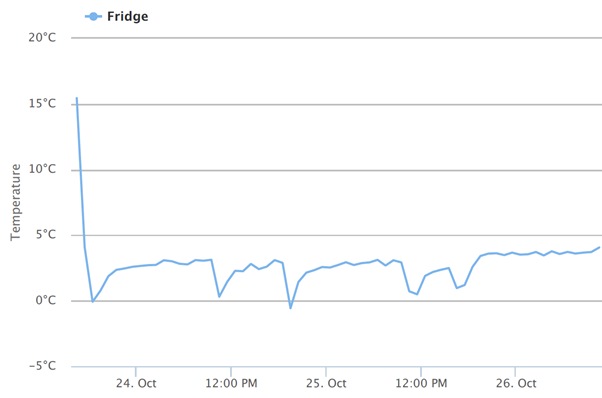
Today I received two graphs from two different brands of temperature sensors (temperature loggers). The first was a Minnow temperature logger and the other our wireless temperature logger. They had both been in a fridge, side by side. They both covered the same time period and the distinct spikes were at the same time.

Two temperature graphs that look so different

When you see the two graphs they look like totally different locations:
Temperature Sensor Graph 1
Temperature Sensor Graph 2
The first (from the wireless temperature logger) looks like the fridge is incredibly stable with some minor spikes. The second (from the Tempsen temperature logger) looks like the fridge is out of control and oscillating madly.

Which temperature sensor is correct?

The answer is “both of them”. They are both portraying what is happening within the fridge.

Then why do they look so different?

To understand why they look so different, it is critical to understand two concepts – response times and accuracy.

The response time is how long it takes to react to a change in temperature. Thermal latency is another term meaning the same concept.

Something with a fast response time will show changes very quickly and will tend to reflect the air temperature very well. They will respond to things like the door opening and closing as well as the fridge turning on and off.

Something with a slow response time will take much longer to show a change in temperature. It will gradually change with time. It is more likely to reflect the product temperature and not the air temperature.

A simple analogy

Imagine a pile of feathers and a pile of bark. When the wind blows the feathers will quickly move in the direction of the wind. The bark will slowly move but it will take a stronger wind and they won’t move as far as the feathers. Both will move but one is incredibly sensitive to the wind.

But they are both meant to be within 0.5°C

The graphs, however, are different by not 0.5° but 5°C. Surely one of them has to be wrong?

And the answer again is, “they are both right”.

The term accuracy is used to indicate how close the sensors are to the actual temperature. The critical point, however, is that it is measured once they have reached a stable temperature. That is, they are monitoring a temperature that is constant, and they are not tested until they reach a constant temperature. It ignores how long it takes for them to reach a constant temperature (it could be seconds or minutes).

So both the Tempsen and wireless temperature logger would show the same temperature if they were given plenty of time to respond, AND as long as the temperature didn’t change.

The reality is that “accuracy” is hidden by fast changing temperature.

Which temperature sensor is better?
So does that mean the Tempsen temperature sensor is better because it reacts quickly? Yes and no. It gives a very good record of the air temperature but this may change too quickly for people and the slower response is preferred.

BUT it is possible to slow the response rate down by placing the logger in a box or bottle. It is not possible, however, to speed up the response time of a logger.

What is covered with our shipping insurance?

Our normal terms and conditions (like most businesses) is that you take possession the moment an order ships. If the order is lost or damaged in transit then, in theory, it’s your problem. In reality we will have a conversation and try to work out a good way to resolve the issue where we are both happy (or not too upset).

Shipping insurance is there to remove the drama. If an order is lost or damaged in transit, we will simply send out a replacement, and we will then deal with the courier directly to resolve the original problem.

Our shipping insurance also means that if an order is delayed beyond what is normal and reasonable then we will send you another shipment (stock levels permitting). Then you should receive one of them sooner, and when the second one arrives you simply Return To Sender.

How much is shipping insurance?

Shipping insurance is 5% of the cost of the goods.

Is it worth it? Practically we have had far less than 5% of shipments have problems. It is, however, what Australia Post and other couriers charge. Ultimately insurance is about peace of mind and less hassle when something does go wrong.

Shipping insurance as an option

Shipping insurance is offered as an option on all our web sites. You can select it at the checkout.

For large orders our staff may also ask if you would like shipping insurance.

If you would like shipping insurance on an order you are placing with us, just ask.

Mandatory shipping insurance

Unfortunately we have had a couple of large orders not make it and then the customer refused to pay. A friend suggested that the easy way to avoid the dispute is to insure any shipments where we have a significant risk.

If you would like an immediate line of credit (30 days to pay) and have the goods ship immediately (no credit check delays) and are purchasing over $500 then we will add shipping insurance to your order.

The shipping insurance can be waived if the order is between $500 and $2,000 and you provide us with a formal confirmation that you accept responsibility of the goods once they ship.

Alternatively you can prepay by direct deposit or credit card.

What is not covered?

If there is a clear proof of delivery to the shipping address provided then we class that as delivered. Unfortunately there are cases where it is lost somewhere between the loading dock or receptionist and ending up in your hands. But we also know that a photo of the bag against a generic grey background is not proof of delivery, it is just proof of existence! It needs to be a reasonable proof of delivery.

It also doesn’t cover the expectation of overnight delivery. For example, if we were to ship to Melbourne (we are in Sydney) then we would expect it to be delivered within about 3 days. Most of the time it is overnight, but there are enough floods and other issues that regularly cause minor delays. Sending a second order the next day tends to not fix the problem. If it is super urgent, talk to us about how we can minimise the risk.

For damage claims we ask that you contact us immediately and we will probably ask for photos or some proof. The shipping insurance doesn’t cover claims weeks later. We do have warranty covering our items, but it excludes physical damage (e.g. being dropped). If the goods are damaged in transit then please let us know ASAP so we can cover it under the shipping insurance.